
-S@

The Interdisciplinary
Creative Specialist

Community Engagement Artist
Greetings! I’m Sandy – I live in Tacoma, WA and work for Peer Community, as a Peer Services Specialist located inside the Parkland-Spanaway Pierce County Library. – All opinions are my own; this is my personal website showcasing my art, my voice.
The vision of my art is to exhibit an interactive BELONGING conversation within a community setting.
The results are measured based on 1subjective feelings/cognitive sensations (pleasant or unpleasant) for community connection; as well as personal, internal activation or sense of validation; time scales should be taken into consideration. A real goal being long-term sustained self-regulation that are viewed by the individual as holistic.

253-359-1150
Hours at library:
Tuesday-Saturday, 10AM to 6PM
sandy@peercommunity.org
CURRENT PUBLIC EVENT
Exhibit: What does it mean to be Hoopman?
Location: Summit Pierce County Library
5107 112th St E, Tacoma, WA 98446
Time: End of August 2026
What is a “Belonging” Conversation?
The definition of Belonging used here is based on the work of john a. powell, from UC Berkeley’s Othering and Belonging Institute, who is the architect for the original Government Alliance on Race and Equity (GARE) program. The GARE program was co-created with powell2 who has evolved his philosophy into Targeted Universalism, with the first step being, “Set universal goal based upon broadly shared recognition of a societal problem and collective aspirations.” My facilitated community art engagement works to facilitate this first belonging conversation, bring everyone into a shared universe of information and bridging a gap in systemic disenfranchisement. Othering becomes a belonging conversation, as we list the same violations of rights against hoopman, our shared-self.
To accomplish this, my art exhibits a macro-look at fundamental aspects we all share regardless of gender, sex, race, age, ability, demographic, appearance, geography, money, language, etc. A sense of Belonging is accomplished by using generic terms for the systems of power existing across all fields, combined with self-evident dynamics, and with a group-dialogued thought experiments. This isn’t magic but a process that is easy to follow.
Othering conversations are not bad, they dial into the differences we have that make each of us unique; ironically, this is the opposite goal of a Belonging conversation which focuses on our similarities. Together, they hold greater power as first a Belonging conversation sets the stage for solving the Othering of society.
Pain conversations? It is counter-intuitive after years of being forced by society to submit to compromises that were not even fair but harmful to communities. That is real and why my Belonging conversations are based on self-evident systems that don’t require faith or trust but with mechanisms of mutual accountability. By asking all communities to hold their stories, the purpose of prioritizing the Belonging conversation is to set the stage for everyone to tell their story and be heard but also, supported appropriately.
Othering conversations may be used to celebrate sub groups or to separate them further. Belonging conversations, in turn, may be used to celebrate the masses or to deny the realities of others. My art uses one to segue way peacefully and united, into another.
This process works so profoundly because fundamentally, we don’t all agree on what it means to be human which has so far been inspired from a huge mixture of past traditions, experiences, incomes, etc. Modern, scientific ideas hold new insights but are more easily digested with the aid of art – because why shouldn’t it be fun. For all the laws pushing people together, we are still segregated often in our hearts based on income, sports, ideologies, language – life is heavy and it is easy to lose focus on what we all share when we are suffering.
I start with a Belonging conversation to help create a shared universe of information; from there, talking about self-evident rights means embracing all aspects of Others to bride stronger connections.
CURRENT PROJECT:
What does it mean to behumanHoopman?
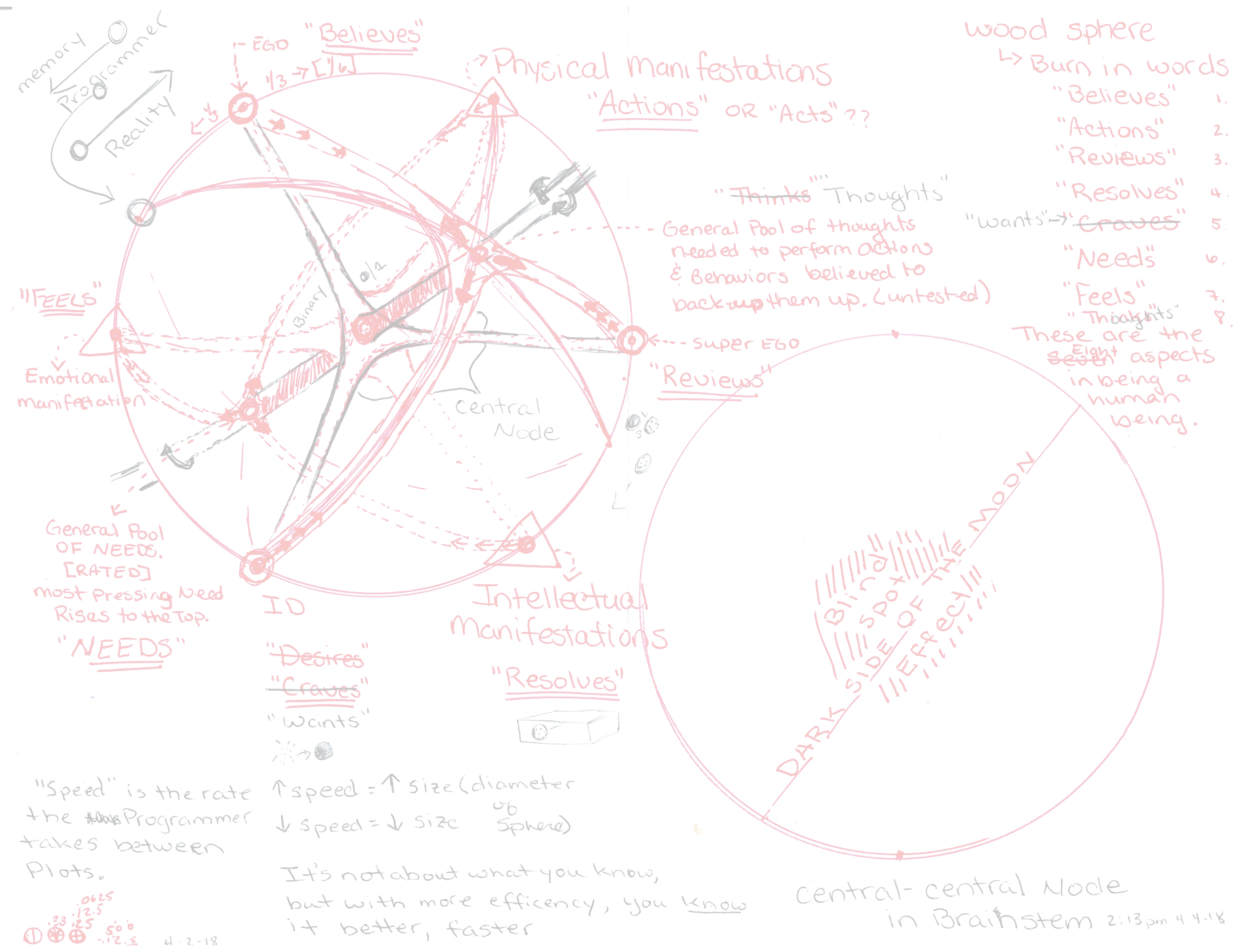
To achieve this Belonging conversation, I start by reviewing basic science and mathematics, not higher than a fourth grade elementary/secondary level. This creates a framework called Hoopman, both philosophical and tactical construct that shows how individuals evolve answers to fundamental questions and in which the community engages with by adding their own answers/experiences.
From there, the community conversation may shift (time permitting) to understanding the potential self-evident truths and fundamental rights that should exist for a world of Hoopmen.
Scientific Summary
Using the widely accepted general forms of Top-Down and Bottom-Up which are describe systems of power. My work aligns both systems to create a human-like complex system that is self-evident and therefore, capable of being subject to conversation. The complex system used comes from the embedded geometry within Electromagnetism, that same fundamental substance of the universe3.
The basis for the top-down embedded system is human anatomy and psychology, with each internal systems’ layer being responsible for storing answers to a question relevant to it. The layers are 1) Whole body, 2) Nervous systems, 3) Mechanical brain, 4) Ego, 5) Super-ego, and 6) Id. The bottom-up system used to express a flat-processing of power, is taken by evolving geometry into a spherical or multi-dimensional light system. This process might seem excessive but the evolution is quite simple and aligns the whole model with the substance underlying everything: Electromagnetism or Light. The end result is a complex system that allows for a dynamic combination made with the fewest pieces4.
Philosophical summary
As already stated, the first philosophical ideology underlying my work is that of Othering and Belonging by john a. powell which includes concepts of Targeted Universalism. With the lofty goal of identifying a universal goal with complete strangers at different levels of disenfranchisement within a group setting, the engagement philosophy needed to include a wide range of respected precedences.
The first precedences is from the foundation of America’s Independence and the document that declared it, is therein set forth. It is ‘decent respect’ to share concepts relating to that which could redraw boundaries of reality specifically those that hold self-evident truths, a conversation on corresponding rights, and the ability to be ruled by universally accepted principles. Self-evident’s truths are not statements that gas light which uses force of will but rather, they contain something observable which manifests the truth of itself, also known as a meta-experience. Self-evident truths coupled with group observations and debate has been the basis for scientific study science at least 16605.
Further more, the use of top-down and bottom-up power systems are implicitly referenced as, “the powers of the earth, the separate and equal station to which the Laws of Nature and of Nature’s God entitle them.”
The Declaration’s next sentence sets forth the concept of self-evident truths being the basis for a respectful debate but also, by “laying its foundation on such principles and organizing its powers in such form, as to them shall seem most likely to effect their Safety and Happiness.” This is in alignment with the goals of Targeted Universalism and my facilitated conversations on Belonging which offers the ability to put power back into community without draining its people, land, or freedoms.
Should I have to defend my art on what it means to be human? It seems a heavy burden to pay for proof, but it is a courtesy due prudent governments who will get to see their failures as future organizing rolls. What is self-evident to the masses has the power to unite ‘those who love peace6‘ and give them (ideally) the ability to organize more effectively then ‘those who profit from postponing it pretend7.’
- James Russel, Circumplex Model of Aspect ↩︎
- https://www.racialequityalliance.org/who-we-are/gare-history770 ↩︎
- https://asandyfoundation.com/business-welcome/embeds/ ↩︎
- https://www.wolframscience.com/nks/ ↩︎
- https://royalsociety.org/ ↩︎
- Taken from quote from Martin Luther King Jr, “Those who love peace must learn to organize as effectively as ‘those who love war.’” ↩︎
- Taken from poem by Norman Colwin’s poem, On a Note of Triumph ↩︎

